Up the East Coast of Tasmania

This post takes us up the scenic east coast of Tasmania, starting on the 4th of March 2024.  Our first stop was in Freycinet National Park (NP), where all the NP campsites were booked out.  We found a free camp, Rivers and Rocks, which was nice but overcrowded.

This was the view near our campspot, so it was worth it camping there.
This was the crowded, free campsite where we got blocked in both nights.

There is so much to see in Freycinet – great scenery and lots of walks.  We made the most of our day there, starting with Wineglass Bay.  Sometimes, especially in Tassie, one has a day with ao much beautiful scenery its almost overwhelming and certainly its stunning and inspiring.  The 5th of March in Freycinet was one such day.

It was a nice walk to the Wine Glass Bay lookout with lots of stunning views.. We decided to skip the 1000 steps down to the beach and back!

We did the boardwalk up to the lighthouse – great vistas.

The main street of Coles Bay with more fabulous views. We ended our scenic day with an ice cream stop here. 7 k’s walked, lots of stairs and perfect weather. What’s not to like!
The Friendly Beaches – our final stop as we were leaving the Freycinet Peninsula. We did a 2.5k walk on that beautiful beach.
Next stop was Bicheno where we saw the blow hole in action and enjoyed a lobster lunch. Doesn’t Dick look happy here!
Stayed at Chain of Lagoons free camp. Most free camps here are very crowded, so the swans made the best photo.

We went through the town of St Helens, left the coast and started to head up to the northernmost corner on the east coast.

On the way to the cheese factory, where we stopped for tasty cheese and fudge, we saw heaps of cows. That whole day of driving north we saw over 2000 cows, some sheep and horses, as we passed through forests and farms.
St Columba Falls were impressive and one of the highest in Tassie with a 90 m drop.  It was worth the walk to see them.
We made it to Cape Portland, top north east corner, where we camped at Petal Point. Finished the day with a walk on the beach and playing our ukes (a 6.5 km walking day).
Our next stop was the Tebrakunna Wind Farm, in the middle of nowhere at Cape Portland, They had a geat display centre with lots of interesting information about the build and operation of the Wind Farm, which is 75% OWNED BY SHENHUA GROUP IN CHINA.  They also displayed good information on the original inhabitants of the land there.

Now I found learning about the wind farm VERY INTERESTING.  If that does not interest you, I suggest you skip this paragraph.  The wind farm is spread over the 5500 hectare property of Cape Portland.  They had to build 70 km of tracks to provide access to the sites of the 56 turbines.  64 km of underground cable connects the turbines to the control building.  In this area the average wind speed is 33 km/hr.  Turbines turn at 12 km/hr and they stop turning at 90 km/hr.  To build the foundation of each turbine requires 80 truckloads of concrete, 64 tonnes of reinforcing steel and 9 tonnes of anchor bolts.  Each foundation weighs more than 1250 tonnes.  Each of the 56 turbines was transported to the site in pieces.  In February 2013 the first turbines were erected by two cranes (one was a 500 tonne crane and the other was a 1200 tonne crane).  Both were brought to Tasmania for this job.  The towers are 80 m high.  Each turbine generates 3 Megawatts.  There are 3 blades per turbine.  The blades are 44 m long and weigh 7 tonnes each.  They were made in China and Italy.  Sounds like the Chinese believe in renewable energy.  Too bad they own 75% of this wind farm.

These next two slides were displayed on the wall inside the display centre at the Tebrakunna Wind Farm and outline the history of the local people who originally inhabited Trouwunna, Tasmania.  It makes sobering reading.

From the wind farm we drove across the peninsula to Mt William NP and camped at Stumpy’s 3 campground, right near this lovely beach.
Great place for exploring along the beach, more black swans and the lovely red rocks; so a good 4.5km walk.
Our campsite at Stumpy 3 campground with our friendly visitor
We enjoyed the Mt William Summit Walk (45 minute trek to the top) and the panoramic views.
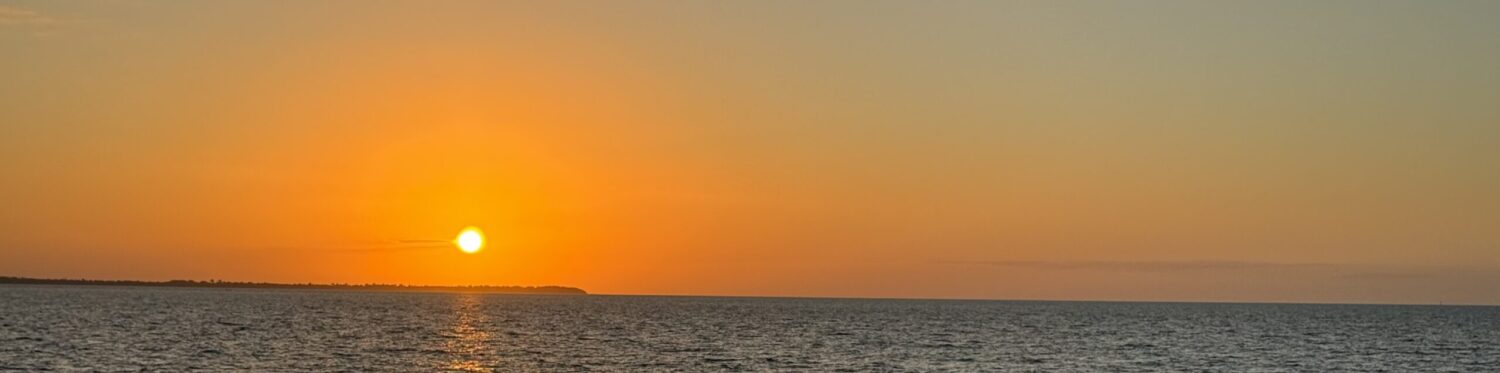
It was a lovely spot to camp, mostly locals not tourists in that area, lots of good walks and we finished off with a beautiful sunset.

We returned south back to St Helens to resupply before camping at Seatons Cove in the Bay of Fires.

Our campsite overlooked the picturesque Seatons Cove. This is classic Bay of Fires scenery with those stunning red rocks.

The Explorer Motorhome (MH) Rally at Cozy Corner South was our next stop and it was a 4 minute drive.  Actually it was a very casual get together of 12 Explorer MHs/20 people.  Lots of chatting and a great group photo on the beach.

Group photos, happy hour and a sign made of seaweed on the sand.
This is what we looked like from the air (or from the drone).
More great rocks to clamber over.
Binalong Bay, near St Helens, marks the start of the Bay of Fires and gives a taste of the great scenery to come as you go north.

After the rally we checked out Binalong Bay and then treated ourselves to a night in St Helens and dinner out. We made sure to get another lobster and salad lunch before leaving the coast.

This map outlines the route we took in this blog post.

Next stop on the 15/3/24 was JACOBS LADDER and that heralds the next blog, which will cover the last two weeks of this trip.

Crossing through the middle of Tasmania

This blog takes us from the west coast of Tasmania through the centre to the east coast.  We were still travelling with Steve and Denise and our first stop after leaving Strahn was in Queenstown. It is an historic mining town, nestled between Mt Lyell and Mt Owen, that features a cratered moonscape.  We were not overly taken with the town, in spite of the fact that I had naming rights on a few prominent sites, so we walked around the town, visited the lookout and then moved on.

 I focussed on these two locations when we walked around the town.
The view from the lookout in Queenstown – mountains and not much of a town to look at.  Dick would have been happy to skip stopping there.

It was more interesting to stop at the Iron Blow Lookout.

We were on a cantilevered lookout over the Iron Blow Mine pit, where copper was mined in the late 1800’s.  The moonscape is a result of the mining and the aqua blue water is due to high levels of copper exposure.
There are 35 kms of MTB (Mountain bike) tracks on Mt Owen and lots more in the area – you can see some of the hairpin curves in the top picture. In this area we did the Horsetail Falls walk, which may be something to look at when there is lots of water around, but it is called seasonal and we were not there in the right season!  It is supposed to be a 50 metre waterfall at the foot of Mt Owen.
Lots of mountains everywhere as our little Explorer motorhome convey wound its way through the area.
That night we camped at Lake King William, which was created by Hydro Tasmania in 1950 with the construction of the Clark Dam across the Derwent River.  There was not much water in the area where we camped, but some wildlife! Interesting as the Tasmanian tiger has been extinct since 1936.

Our first stop in the morning was the town of Derwent Bridge (population 40), where we visited an amazing place called ‘The Wall in the Wilderness’.  This ambitious art project has been created and designed by Greg Duncan who is carving the history of the Central Highlands of Tasmania in 100 meters of timber 3 meteres high, mostly Huon Pine.

Set out in relief sculpture the work depicts the history, hardship and perseverance of early settlers. The work has an uncanny realism and some of the carved pieces in the foyer looked absolutely real. Each one metre of panels represents a month’s work.  These photos don’t do the work justice BUT there are no photos allowed! So I bought a fancy brochure that had good photos and I have used copies of those.  The work covers the history from the indigenous population to pioneers harvesting timber to pastoralists to miners and hydro-electric scheme workers.  THIS IS A WORLD CLASS EXPERIENCE – there is nothing like this anywhere else in Australia.  If you ever visit Tasmania, put this on your list.  I rate it one of the best things we saw on our travels in Tasmania.
We stayed at Tarraleah, which is a former hydro construction village (from the 1930’s – 1980’s) now turned into an estate that caters for tourists.  In 2023 it was bought back by Hydro Tasmania for $11.2million.  With limited camping places it is usually hard to get in, but we were in the middle of a bush fire danger area so there was room for us to camp.  We were told that if the fires got closer we would have to leave immediately.  However the sports field was a parking lot for the firefighting helicopters and all the crews were staying there.  The woman who checked us in said that the fire fighters must have thought it would be safe there or they wouldn’t all be staying there. We ate dinner in the pub with Steve and Denise – our last evening together as we were heading off on our separate ways.

We headed for Lake Pedder, Lake Gordon and the Gordon Dam.  After hearing about the controversy over the flooding of Lake Pedder and the completion of the Gordon Dam in 1974, we were keen to see the area.  On the way in we bumped into another three Explorer Motorhome contacts and decided to camp with them at Ted’s Beach on Lake Pedder.

On the drive into the Gordon Dam we saw lots of mountains, interesting art works and glimpses of Lake Pedder.
Amazing views of the Gordon Dam and Lake Gordon, the largest water storage in the country.  We spent a lot of time walking across the top of the dam and enjoying the views.  The dam and power station are associated with the construction of the first road into southwest Tasmania, and the controversy over the flooding of Lake Pedder.
Lake Pedder and Lake Gordon combine to form Australia’s largest water storage, covering more than 500 sq kilometers and holding approximately 31 times the volume of water in Sydney Harbour.  The Gordon River runs from here to Macquarie Harbour in Strahn where we did that boat cruise.
Not sure why we were camped behind the beach area with the view but we were the last to arrive, so not our call.  The flooded Lake Pedder now has a surface area of approximately 242 sq kilometers.  It was the flooding of Lake Pedder that saw the birth of the United Tasmania Group, the first green political party in the world.
At Strathgordon we saw this massive Huon Pine log. This log was salvaged in 1975 from the area now covered by Lake Gordon.  At the time of salvage this Huon Pine was 2200 years old and had a circumference of 8 meters.  Its age was established by CSIRO (Commonwealth Scientific and Industrial Research Organisation) and the markers on the tree rings indicate the size of the tree and what was happening in the world at the time.  For example, the first marker says – “AD 68 DEATH OF NERO EMPEROR OF ROME. The sixth marker says – “Magna Carta signed by King John 1215”.  Huon Pine only gorws in the wet, temperate rainforests of SW Tasmania.  They do not start to reproduce until 600-800 years of age and their timber has remarkable properties.  It has a high oil content which renders it impervious to insects, waterproof and it does not rot.  It can be bent, shaped, worked and sculpted without splitting and finishes to a superb, fine lustre.  Woodworkers love it!  Dick used it to do a major rebuild on his boat in the early 90’s.

Given we had been in Hobart many times, we decided to have three nights in a caravan park in Huonville, a small town south of Hobart.  It was a relaxing and social stop.  We visited an old friend of mine from Dress for Success days, Kerri and her husband Rob, We also caught up with friends from our Arnhem Land trip, Jan and Paul, over a lovely lunch.

The view from our bedroom window for two of our three mornings in the caravan park.  Not a bad place to have a few days to relax.
We had a great catchup and a yummy lunch with Jan and Paul who gave us lots of travel tips for the rest of our time in Tassie.  That Arnhem Land trip we did with them had a big impact on all of us.
A big bonus of staying in that caravan park was that the park supported the ‘Save the Tasmanian Devil Program’ and had two Tasmanian Devils which they featured in a close-up show for their guests.  Tasmanian devils are threatened by the Devil Facial Tumor Disease, a type of cancer which could wipe them out eventually.

From here we headed up the east coast of Tasmania and on to another scenic part of this small and very scenic island state.