Following a hectic 7 months being political campaigners for an independent candidate in the federal election (who did win), we took a quick trip to Queensland in June looking for some warmth and a change of scene. The first night away did not bring warmth – in fact the water in Belle froze when we camped at Willow Tree. My idea of going up on an inland route and back down the coast didn’t seem so clever after night one.
11/6/22 Frost on the ground and frozen water pipes at our first camp in Willow Tree.Its not often we get to drive by fields of cotton, but we saw lots of these in northern NSW around Gunnedah.
After a quick stop in Gunnedah to buy warmer pj’s at Best & Less, we went straight to Moree and the hot springs. We like staying at a caravan park that boasts four hot springs (one at 36, 37, 38 & 39 degrees C) and a soak in the pools felt like a good idea. So good that after dinner in the van, we also had another soak.
In our haste to get into Queensland we drove 500 kilometers over 5 1/2 hours and stayed at a bush camp we had visited previously.
Our bush camp at Barambarah, near Murton, Queensland.
Given our destination of Hervey Bay was within reach, we had time to stop along the way so Dick could do his regular balance class on Zoom. I did a thorough tour of the shops in the town of Goomeri (population 664), which was a nice little town with a pumpkin festival and lots of gift shops, while Dick did his class in the local park.
Dick keeping up with his balance classes on Zoom.
I was keen to return to Maryborough as its an interesting little town, and has a Mary Poppins connection. We only had time for a brief lunch and loo stop.
The locals in Maryborough say they have the fanciest toilets in the world and they offer tours of them. We couldn’t understand why there were so many people standing outside the public loos – they were tour guides!
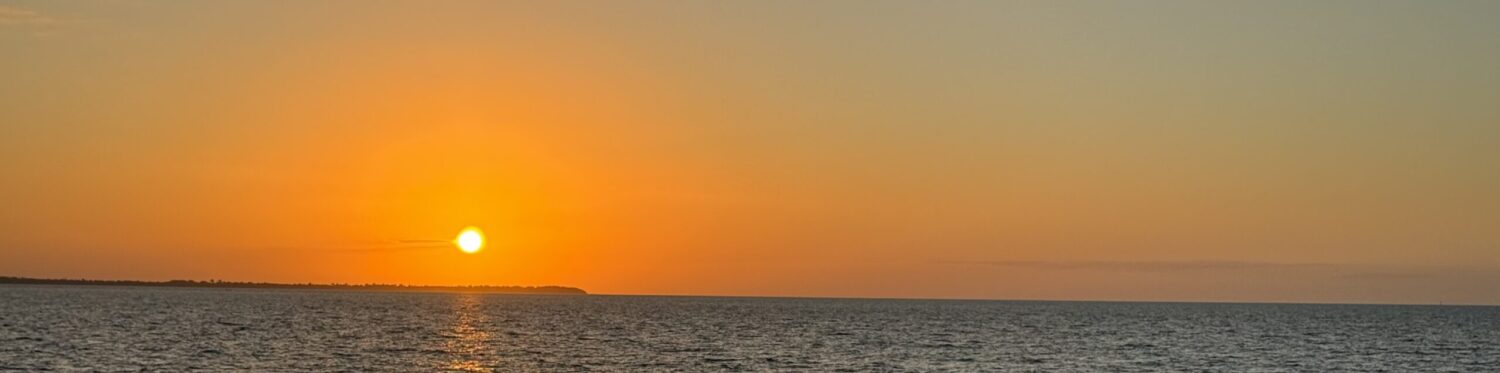
Then we settled into our caravan park in Hervey Bay, home for three nights. I managed a nice sunset beach walk. After four days of driving it was good to have some down time, and Dick was not well with a cold. Also I had a favorite dress shop to revisit, and nice beaches to walk, and sunsets to photograph.
It was nice to feel warm and enjoy a long walk along a beautiful beach at Hervey Bay.This Urangan Pier was built in 1917. It is 868 m to the end and another nice sunset walk.I couldn’t resist the stunning Hervey Bay sunsets.
We also went back to Maryborough to visit the market and particularly to visit the Mary Poppins Museum, which is located in the old bank building where PJ Travers, author of Mary Poppins, was born. The museum tells you all you’d want to know about PJ Travers and Mary Poppins.
A good opportunity to say hello again to my old friend, Mary Poppins. They really love her in Maryborough.
From Hervey Bay we caught our flight to Lady Elliot Island, where we spent 3 nights. The 35 minute flight was on this 12 seater plane.Coming in to land on Lady Elliot Island – the runway goes thru the middle of the island. Its a 45 hectacre (111 acres) coral cay, the southernmost island on the Great Barrier Reef. Its in a highly protected Green Zone and is a sanctuary for more than 1200 species of marine life.
On arrival we were given an orientation tour before lunch, and then we saw a presentation on manta rays in the Reef Education Centre. The resort is an eco resort and has been recognised for its dedication to the protection and preservation of the natural asset. Guests are asked to commit to the island’s sustainability pledge.
It is possible to walk around the island in 45 minutes, so we started to do that on our first day.We got as far as the sunset drinks – what else could we do!Two views of us enjoying the sunset drinks. We did not move from our chairs, just looked different ways to face the camera.
Evenings were fun with quiz nights, island bingo, guided night walks or games. We soon had our regular group of friends to spend the evenings with.
Named one of the top five destinations in the world to scuba dive with manta rays, and being one of the best barrier reef locations to dive and snorkel; is what attracts most visitors. So on day 2, I did a refresher snorkeling lesson and then we snorkelled in the lagoon. The water was not deep but we saw lots of colored fish. The island offers lots of education presentations and land tours as well as snorkelling and diving trips. We went to the whale presentation, saw a bit of fish feeding and did a guided reef walk.
Day 3 was our glass bottom boat/snorkel tour and we saw a manta ray under the boat. I snorkelled with the instructor and we immediately saw a large turtle plus lots of fish, coral, giant clams, green parrot fish, and sea anemone. Being in the sea is not my most comfortable state but I am glad I did the snorkel trip, since we were in one of the best places to do that.
Another sunset viewing on our last night.Before we left we had time to do the ‘Behind the Scenes’ tour, where we learned about how the island manages power (batteries & solar), waste (treatment and return to the water table) and water (desalination). They are proud of their sustainable solutions and happy to explain all to their visitors. Here we are in the battery room hearing from the maintenance guy.Back on the coast Dick wanted a beach camp and I was happy anywhere with good internet, so we had two nights at Inskip Peninsula, just north of Rainbow Beach and near the ferry to Fraser Island. One beach walk and a day on the phone sums up our stay, after we had no phone or internet service on the island.We then enjoyed a great day with our friends, Janice and John, who introduced us to the Noosa Everglades, one of only two everglades in the world. We’ve now seen both and they are very different. Our day started with a lovely lunch at Kin Kin and then we drove to habitat noosa on Lake Cootharaba. The lake is known as the gateway to the everglades and its 10km long and 5 km wide with an average depth of 1.5m (5 feet). We are cruising across the lake on our eco tour to the everglades.We are still surprised that we had not heard of the everglades on our multiple trips to Noosa. Over 44% of all of Australia’s bird species reside here, more than in Kakadu Park in an area 25 times smaller.We had a lovely cruise – the afternoon light really highlighted the reflections and it felt like we were in a very special place. Only 20 kms from Noosa, it felt like a world away.
Before starting the drive home we caught up with a few friends; a quick visit with Gordon and Joanne, lunch with Pamela and Rod and later dinner with Allan and Barbara and an overnight in Allan’s driveway, our favorite driveway camp. We also had to visit Explorer Motorhomes in Brisbane for a water pump repair. Having no heater and then no water, our trip was starting to feel like real camping!
Another good visit with Allan and Barbara, this is just before Allan is off to bowls.Decided to take a look at the Glass House Mountains as we were driving by. They were named by Lieutenant James Cook in 1770, as they reminded him of the glass furnaces in Yorkshire. The 12 mountains are the remaining cores of 26 million-year-old volcanoes. We did the walk at this lookout and also admired the mosaics set in the lookout walkway.Our drive home featured some nice beach walks as we camped at Kingscliffe and then this place at Grassy Head – nice camp with a 3 k walk on a beautiful beach. From here we had a lunch stop with Mick at Port Macquarie before getting to Anna Bay.Our last night away was spent with Jen and Kevin at their place at Anna Bay. We also managed a beachside lunch stop before we left.Of course we were keen to get home to see the grandkids. Here is pied piper Dick playing his harmonica for Seb and Jake.And a cuddle with little Ruby, now 10 weeks old.
Our winter escape was 17 days, 3000 kms, fine weather, visits with friends and lots of variety. Good to be home and here to celebrate the boy’s first birthday. Not so good that we have covid but it seems inevitable these days and much better to have it at home. Best regards to all.
Since the route home was unplanned, the last part of our trip through Queensland and NSW was about finding new places to explore in territory we had passed through a few times, and we managed to find some….
This is the map of our trip home from Boulia (3900 kms over 22 days).The caravan park in Boulia, (population 300 and Land of the Min Min Lights) was good for a three day rest and it came complete with camels, a pony, chickens, goats and brolgas. The pony was keen to check out Belle.
Aside from doing laundry and emails, joining in for happy hour and eating in the pub one night, the one Boulia attraction we visited was ‘The Min Min Encounter’, which is a 45 minute laser and animatronic show. It was an impressive show and display telling the story of the Min Min Lights, unexplained balls of glowing light that appear to travellers at night in this area. The show features stories of people’s experiences where the strange light follows them home or just appears around them. It was a bit spooky and scary for some of the people who spoke in the videos. The woman who did our tour was a local and she was very authentic, so I asked her if she had ever seen the Min Min Lights – she said she had driving home late one night, they followed her home.
Just out of Boulia on the road to Bedourie, we stopped to check out a small grove of protected Waddi Trees. There are only three stands left in Australia. We did see another stand in the Northern Territory a few years ago. Some of these trees are almost 1000 years old and the timber is almost impossible to burn.This is the view from the Vaughn Johnson Lookout, which is the highest point on the cusp of Diamantina Shire and overlooks the Queensland Channel Country. We drove through a lot of very flat land, lots of floodway signs and no towns.We were attracted to the Bedourie Aquatic Centre and Thermal Spa, so we stayed two nights in this town of 100 people. In 1905 the artesian bore was sunk to 1213 feet and in 1970 their electricity was connected. I liked the Dust Storm sculpture and the Aquatic Centre with its 25 m pool was nice at 30 C, unlike the thermal spa at 41 C. As a bonus, they had good internet!On the drive to Windorah we came across an airstrip on the road.Found a lovely free camp at Cooper Creek, near Windorah. Quiet, pleasant view and INTERNET! Good for a 3 day rest stop.Our second visit to Quilpie (population 600) was much better than the first. These are the two different campsites we had staying at The Lake Quilpie. We moved from the lakeside to be closer to the amenities, the laundry and the happy hour!HAPPY HOUR at Lake Qulpie. This one had a fire and a bar. Good place to meet people and compare travel notes.Dramatic sky at the end of a day in Quilpie. We had a nice day exploring the town, unlike the previous visit on a Sunday when everything was closed. Visited galleries, a museum, did all the normal stockup chores, had lunch in a cafe and even managed some retail therapy (new outback shirt for me).Sunset drinks at the top of Baldy Lookout with Paul and Jenny who we met at Happy Hour the night before.Eromanga (population 120) is another special dinosaur stop. Their Natural History Museum, now in a fabulous new building that only opened four months ago, houses bones from the largest land dwelling animals – ever. Cooper, named after Cooper Creek and Cooper Basin, is Australia’s largest dinosaur and in the top 10 in the world. Based on the remains that have been found, it is believed he would have been 30 meters (100 ft) long and 6.5 meters (21 ft) high (from ground to hip). Above are reconstructions of the leg bones and the large space is where museum staff and volunteers work on the bones that have been dug up and wrapped until there are people available to work on them. The museum offers Dinosaur Dig experiences and depends on the work of volunteers who work with the palaeontologists and geologists in the field and in the museum. We enjoyed the tour and learning about these discoveries. They also offer Megafauna dig experiences since the megafauna bones found at Eulo are also worked on in the museum.Here is a picture of what Cooper, the largest dinosaur, would have looked like 95 million years ago. The second picture is a life-size art sculpture of a Sauropod and her two babies, which was commissioned for the G20 Summit in Brisbane and donated to the Eromanga Natural History Museum.Leaving Eromanga late afternoon we found an amazing free camp and caught another ‘red rock’ sunset.Its only for a couple of minutes, but those end of day colors are stunning. Here we have our own light show and no one else for miles around.
For those unfamiliar with the history, Burke and Wills were the first explorers to cross Australia from south to north in 1860-61. The expedition was fraught with disaster and both Burke and Wills died after achieving their goal, primarily because their supply team at the depot left the depot just hours before Burke and Wills returned from the coast. The Dig Tree is located at that depot, and is the place where supplies were buried so the local aboriginals would not find the supplies. The supply team wrote ‘DIG’ on the tree to alert Burke and Wills that they needed to dig to find the extra supplies left for them. Controversy surrounded that expedition and there are still conflicting reports being debated today.
During this trip we listened to the audiobook, Burke & Wills by Peter Fitzsimmons, so it felt appropriate to visit the famous Dig Tree. Here is the entrance with lots of signage explaining the history of the Burke & Wills Dig Tree. The station owners provide free camping along Cooper Creek at the Dig Tree, so we found a nice camp for the night.There are three significant coolabah trees here that Dick is standing in front of. The original dig tree, where the supplies were left for Burke and Wills in 1860. It had a blaze and the word ‘DIG’ carved into it. Then in 1862 a member of the second Howitt expedition to Cooper Creek carved DIG in another tree. In 1898 photographers, John and Minnie Dick, decided to carve a memorial to Burke on the Dig Tree. The owner of the land at Cooper Creek ‘suggested’ they do the carving on another tree 30 meters away; hence the face tree, as you can see above.After a night in a Thargomindah (population 300) caravan park, we decided to do a free camp at Lake Bindegolly NP. The string of salt and freshwater lakes are rain-fed via local catchment areas, and form an important wildlife refuge in this arid zone. It would be quite different in wetter times,This was our 11 km walk at Lake Bindegolly – easy walking, quite boring and no shade. We did see 12 brolgas, a few ducks and birds and one feral pig. Because it was so dry, the lakes were quite shallow and not much bird life around.However, we saw some flowers along the walk.
Next stop was Cunnamulla (population 1140) and as creatures of habit we returned to our old campsite in the caravan park. There we finally decided to return home so we crossed the border and returned to Moree. This time we tried a new caravan park which boasted 6 thermal pools. It was pleasant and would be a good stop if you wanted to lounge about in thermal pools with temps ranging from 36-41 degrees C.
Lots of driving and as this photos shows, some emus can’t resist running in front of cars. That lovely little blue bird was a regular visitor to our camp at Red Rock.After all that time in desert and all those rocks, we decided to indulge with a couple of days on the beautiful NSW coast. Red Rock (just north of Coffs Harbour) is a favorite camp spot – good beach, nice walks, good campground and INTERNET,We enjoyed both beach and bush walks, and even saw this gnome tree in the bush. Sign reads ‘gnome sweet gnome’ so someone has gone to a bit of trouble creating this along one of the tracks. Red Rock was a nice way to finish up our trip, and our time there coincided with a NSW statewide lockdown – right time to be heading home.This is why we were keen to get home. We were home for two weeks before the boys, Seb and Jake, got out of hospital as they were born at 30 weeks. The new grandparents can hardly believe how special it is to be with them.These little guys are doing well and its a delight to be with them. Their parents, Helen and Anthony, are relishing their new roles; so Seb and Jake are in good hands.
Thats the end of this blog and the beginning of a very exciting chapter in our lives,
On our trip we travelled 16,500 kms over 99 days. This is how the final trip map worked out.For those of you interested in statistics, here is the latest summary.