We’d heard about an interesting sculpture trail so we added it into our plans. We enjoyed it so much we decided to make it a blog on its own. Even getting there was an adventure, especially after we took a “shortcut” that turned out to be on private station (ranch) roads with lots of grids, gates and cattle and unintended forays into people’s yards; plus maps showing roads that didn’t exist. Probably was a longer way in the end but we saw different country.
Even without the sculpture trail we probably would have stayed at Lake Dunn (aka The Lake), as Dick’s family used to live at Dunn Lake in Wisconsin.
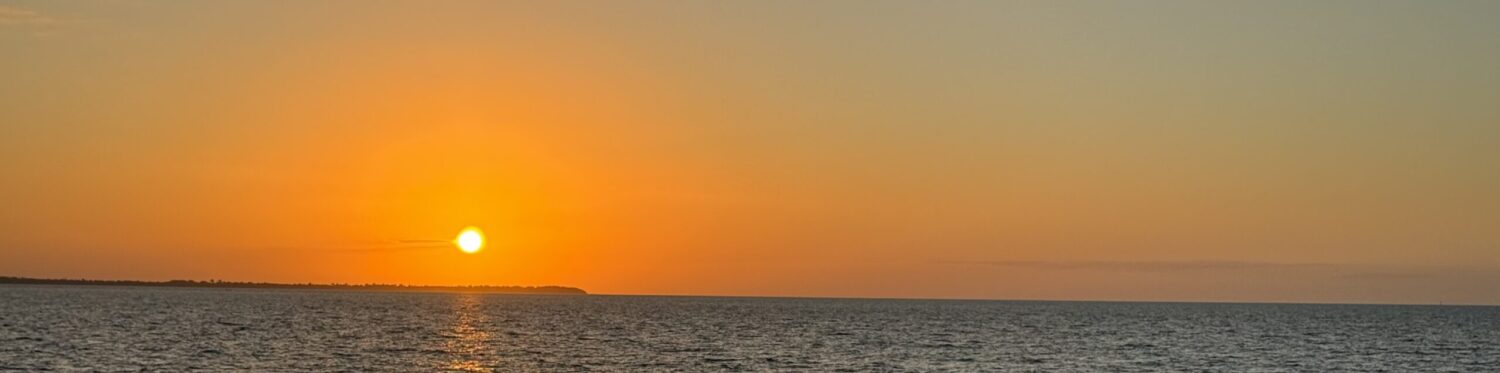
This photo is for Dick’s family. This lake is on private property and the owners allow the public to camp here in conjunction with the local council. The property owner (of 60 years) comes around at 5pm in a golf buggy and collects the fees.We had a nice campsite on the lake with our Explorer friends, Chris and Joanne. After our “shortcut” drive we got there in time for dinner and an evening fire.We joined Chris and Joanne for a morning uke practice, but it must have been hard for them as they are both very good players. In fact they have taught us a lot, and they gave us homework.
The Lake Dunn Sculpture Trail features 40 sculptures along a 200 km circuit. The story is that a local sculptor, Milynda Rogers, decided she needed a platform to display her work. I think she gave a precious gift to her community by providing it with one of the biggest, permanent, outdoor sculpture exhibitions in the world. As you will see, she has combined her love of sculpture and incredible ability to turn junk (ie old farm equipment, nuts&bolts, old kerosine tins, odd motorbike and car parts etc) into art. This was a well-kept local secret but is now becoming an international phenomenon attracting travellers from all over.
The artist gets her inspiration from local characters and animals. We started at The Lake with ‘The Crayfish’Then we saw the ‘Ballyneety Bronc Rider’. She uses a lot of barbed wire in her work, as well as almost anything else you can imagine!This ‘Cutting Horse Cowgirl’ looks quite real from a distance.On a close up look, you can see what she used to make this one.Looks like the local station owners are all involved as well.It took her a couple of days to make these ‘Butterflies’.Here’s ‘Goanna in Gum’This ‘Plane’ was surrounded by cows when we drove up. Some were resting in the shade under the plane.In keeping with the local animal theme, we have ‘Koala in a Tree’.‘Dingo on a Stump’‘Pig’, and this refers to the feral pigs common in the bush. The sort you don’t want to meet!‘Kookaburra’‘White Cockatoos’ on another station gate sign.‘Bottle Tree’‘Eagle and Snake’. Getting these sculptures in place must have been quite a feat as well.‘Motorbike Musterer’, complete wth his dog on the back.‘Thirsty Cockatoos’. 4 X Gold is a brand of beer in Queensland.‘Deer’ – the sculptor was so good at getting the proportions and shapes right, even with the wide array of materials she used.‘Possum in Gum’ – another favorite local.‘Mustering Dog on a Rock’‘Returned Soldier’. Driving up to this it looked very real. Imagine what she had to do to get this one in place.A closer view of this guy, so you can see some of the material she used to make him.‘Eagle and Nest of Chicks’. Her placement of so many of these is so good.
TIRED OF LOOKING AT SCULPTURES YET???? As you can tell by the light the sun was going down so we had to return to camp. Over four hours we saw the sculptures shown above, and just made it back before dark. Weren’t we lucky to have such fabulous weather and not another person around as we did that drive.
Just made it back in time to catch the last of the sun on the lake and to have another dinner with Joanne and Chris.
The next day we left Lake Dunn and completed our pilgrimage seeing every sculpture on the trail. By the way, this trail is in a very remote area, away from any population centres, and most of the trail is on dirt roads.
‘Frilled Neck Lizard’, another part of the local animal series…..‘Emu and Chicks’; not quite the same as the real ones we saw crossing the road earlier and those ones didn’t have motorcycle bodies!‘Echidna’ – lots of workshops would have been raided to make him.‘Rainbow Serpent’, represents one of the great and powerful forces of nature and spirit in Aboriginal society. This one is made with mosaic tiles.‘Jabirus’; my impersonation wasn’t so good but it does show how large they are.‘Jonathan Thurston’ is a well known, well regarded and highly awarded rugby league footballer from Queensland. He won Queenslander of the Year in 2017 and was nominated for Australian of the Year in 2018. It took our sculptor 10 months to build this sculpture of him.‘Pair of Plains Turkeys’‘Harry Redford Drover’; Harry was an infamous drover and cattle thief who carried out the audacious theft of 1000 cattle, including a white bull, and drove them from Queensland to South Australia in 1870, an arduous journey at that time. Eventually he was caught and tried, but the jury let him off because they were so impressed with his achievement. These sculptures illustrate local color and famous stories.Just checking out ‘Ram’.‘Pushbike with Goanna and Kangaroos’‘Roaming White Bull’ – she’s thought of everything on this one!‘Fighting Red RoosNote the detail in these guys – even forks for eyelashes.
As you can tell, we thought this was one of the best things we’ve seen on this trip. Due to our initial shortcut, we finished our sculpture trail in Aramac, the town where most people start the trail.
The main street of Aramac features a statute of the infamous white bull from Harry Redford’s cattle theft, but its 2020 so the statute has a mask. A normal statute looks very plain compared to the innovative ones on the sculpture trail. This little town must get so many more tourists thanks to the Lake Dunn Sculpture Trail, and there is no charge for looking at those sculptures. Its too bad the artist is not rewarded in some way. She said she likes to put a smile on the faces of the people who travel through her beautiful and historical part of Queensland. She has certainly done that!
After leaving Atherton Tablelands we headed for Cairns and had another catchup with Geoff and Vicki. Then we spent three nights at Fishery Falls south of Cairns. Nice restful weekend and another waterfall! Also got live music and a nice Thai dinner, prepared by the park’s Thai owners, in the CP (caravan park) on Saturday night.
Enjoying a tropical breakfast in a tropical setting at Fishery Falls.The Fishery Falls waterfall. Dick can be seen in a blue shirt in the distance near the falls.On his way back from the falls. Either Dick can’t read or he has trouble following directions!
Finished off some errands in Cairns and decided to see Kuranda and return to Mareeba. For a popular tourist destination Kuranda was pretty empty. We visited the Australian Butterfly Sanctuary – no tours running because of Covid, but we saw lots of beautiful butterflies and learned some interesting butterfly facts. The Sanctuary is the largest butterfly aviary in the southern hemisphere, and was established in 1987. They raise approximately 23,000 butterflies per year in a quarantined laboratory.
So many in the sanctuary that its almost like they posed for us. There are 2000 flying free in the aviary, and their average life span is two weeks.Other butterfly facts – they fly by day (diurnal) [moths fly by night (nocturnal)], they taste with their feet, they are the second largest group of pollinators after bees, they have tetrachromatic vision (humans only have trichromatic vision) so see a larger spectrum of color, female butterflies only mate once in their life, birdwing butterflies mate for between 8-14 hours with the male hanging off the female upside down. The biggest threat to butterflies is loss of habitat as without their special host plants, they can’t breed.The Blue Ulysses was my favorite butterfly at the Sanctuary. We also saw them in the caravan park in Cairns but couldn’t get close enough to get a photo.Also visited Barron Falls – massive in the wet, but not so impressive in the dry season. The river falls 250m (800 ft) onto the narrow coastal lowlands and flows to the Coral Sea, just north of Cairns airport.
In Mareeba we found a place we liked (Trinity Plains), not crowded and they didn’t push us out at 10am. so we kept coming back. Had a good rest day; ie two loads of washing, a uke practice and we got the blog out. The next stop was an isolated station stay at Karma Waters on the Mitchell River, with Chris and Chris.
Our own private camp on a river – very scenic and great for relaxing and chatting.Dick and Christopher trying to work out how to use the sat phone!This picture sums up the tranquillity of our camp spot, and is in contrast to my pain from all the midge bites I got.
Two nights of remoteness was enough so we all went on to Cooktown and stayed in Endeavour Falls caravan park, where we got another waterfall and we also got more private camping as the place was almost deserted.
This waterfall was a 5 minute walk from the campground.It was a beautiful campground with thousands of elegant palm trees, and only us and one other there. Chris and Chris left early before we took this shot.
Since we’d been to Cooktown in 2017, there wasn’t a lot to see, but we needed to get more stuff for my bites and caught the end of the Saturday market.
Then we visited Cook’s Lookout, where James Cook and Joseph Banks stood in 1770 to survey their predicament of finding a passage through the Great Barrier Reef.
That evening we joined Geoff and Vicki at another Cooktown campground where we cooked together in the camp kitchen.
Our first meal prepared and eaten in a camp kitchen. Normally we cook in our van.We also had a fire with Geoff &Vicki, and Dick is able to take photos in the dark with his fancy iphone camera.
From Cooktown we headed to Elim Beach which was supposed to be a nice place to camp and is located beside the Coloured Sands. The campground is owned by an aboriginal elder, Eddie. It was quite crowded when we were there and not so appealing.
At Elim Beach we had a nice spot, but the picture doesn’t show how crowded it was.Decided to see the Coloured Sands on our way out, but the tide was in so we couldn’t walk or drive there. At another time, this could have been a lovely beach walk, but it was not to be, and no one told us that you needed to plan around the tides.From here we turned around and started heading south. Decided to revisit Trevanthan Falls. Must have forgotten about the terrible road in and the difficult walk to the falls but we eventually got there and it was as nice as we remembered.
After another overnight stay in our favourite park in Mareeba, we headed for Tully Gorge National Park (NP) and were faced with more “bug wars”. Gave ourselves a rest day, did a short ‘butterfly walk’ near our camp, so learned more about butterflies and saw heaps there. Drove along Tully Gorge to various lookout spots.
Tully is known for the highest rainfall in Australia, with an average of 4 meters (160 inches) of rainfall per year. It is home to a hydro electric power station and famous for its white water rafting.There was no whitewater rafting on when we were there and we think that it may be shut down due to Covid. Generally this world renowned white water rafting experience attracts up to 80,000 visitors annually.Because we hadn’t seen enough waterfalls or done enough steep climbs in the heat, we decided to do a 1 hr climb to Jourma Falls, on our way to Townsville.
Townsville felt like an abrupt return to civilisation as we stayed in a CP in the centre of town and even ate out in a crowded restaurant. As soon as we’d done our errands and phone calls, we headed out to another NP for a night.
We like being on our own in NP’s so we can play our uke’s without bothering anyone, like we are doing here in White Mountain NP.This emu with her six chicks ran along the road beside us for a while, then she decided to cross in front of us and left her chicks behind. They then ran across in front of us also. Good thing we were watching them.
Our next destination was a sculpture trail we had heard about. It was so good, we’re giving it a blog post of its own.